
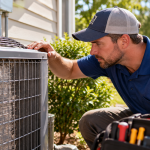

An air conditioner that cools well at night but fades by mid-afternoon is usually overloaded, not failing at random. Dirty coils, low refrigerant, a weak capacitor or an undersized system can all cause it.
Picture a hot July day in Frederick County. The house feels fine at 8 a.m. By noon the thermostat reads 76. By 4 p.m. it's stuck at 82, and the unit still hums along while the heat keeps winning anyway.
That pattern is a clue, not a mystery. Winchester homeowners deal with strong sun, hot attics and humid air all at once. This guide uses ENERGY STAR and U.S. Department of Energy advice to explain what's going on.
Key Takeaways
- An AC that cools at night but fails in the afternoon is usually struggling with peak heat, not breaking down at random.
- A clogged filter, a dirty outdoor coil, low refrigerant and a weak capacitor are the most common causes.
- The U.S. Department of Energy says replacing a clogged filter can cut cooling energy use by 5 to 15 percent.
- You can safely check the filter, vents, thermostat and area around the outdoor unit. Leave refrigerant and electrical parts to a licensed technician.
- Ice, burning smells, tripped breakers or water leaks mean it's time to call right away.
Why Does an AC Cool at Night but Struggle in the Afternoon?
Afternoon is when your house takes on the most heat, so weak parts get exposed fast. At night the cooling load drops, and a tired system can still keep up. At 4 p.m. on a hot July day, it simply can't.
If the pattern repeats every single day, book HVAC repair in Winchester before a small fault turns into a full breakdown. A technician can test the parts that fail under heat, which a cool evening hides.
Afternoon AC failure: This is when an air conditioner cools fine at night but loses ground during peak heat. The cause is usually lost capacity, such as dirty coils, low refrigerant, a worn capacitor or a unit that's too small.
Peak heat load works against you. Sun beats on the roof and west windows, attic air climbs, and the outdoor unit has to shed heat into 90-degree air. Any small weakness shows up fast, usually around 4 p.m.
Why Is My AC Not Cooling in the Afternoon?
Most cases trace back to airflow, heat transfer or electrical parts. Below are the four usual suspects, listed from the cheapest to check to the ones that need a licensed technician and the right tools.
Clogged Filter
A dirty air filter starves the system of air. ENERGY STAR advises inspecting, cleaning or changing filters once a month in cooling season. Airflow problems alone can cut efficiency by up to 15 percent.
According to the U.S. Department of Energy, replacing a clogged filter with a clean one can lower an air conditioner's energy use by 5 to 15 percent. It's the cheapest fix on this list, so check it first.
Dirty Outdoor Coil
The outdoor condenser coil releases the heat your home has absorbed. ENERGY STAR says dirty coils reduce a system's ability to cool and make it run longer. Pollen, grass clippings and dust clog it quickly.
Low Refrigerant
Refrigerant carries heat out of your house. ENERGY STAR notes that too much or too little refrigerant makes a system less efficient. A low charge usually points to a leak, so topping it off isn't a real fix.
Weak Capacitor or Fan Motor
A capacitor gives the compressor and fan motors their starting jolt. When it weakens, parts run hot and slow, and the unit may shut off on hot afternoons. It stores a dangerous charge, so call an hvac service in Winchester.
Homeowners searching for HVAC Winchester VA help often learn the cause is one of these four parts. Knowing which one speeds up the visit and keeps the repair bill more predictable for you and your budget.
What Can You Safely Check Before You Call a Technician?
You can safely check the filter, thermostat, vents and the area around the outdoor unit. Skip anything that needs a panel removed, because capacitors and refrigerant lines are for licensed technicians only.
- Replace or clean the air filter, then run the system for an hour.
- Set the thermostat to Cool and the fan to Auto, and confirm the outdoor unit starts.
- Open blocked supply vents and clear furniture from return grilles.
- Clear leaves, weeds and debris away from the outdoor unit.
- If you see ice on the indoor coil or refrigerant line, switch the system off and let it thaw.
These steps take about fifteen minutes. If the house still lags by four in the afternoon, call an hvac company in Winchester. Write down when the problem starts, since that detail helps a technician narrow it down fast.
Could Your AC Be Too Small for Your Home?
Yes, an undersized system runs nonstop on hot afternoons and never reaches the set temperature. A unit that once kept up can fall behind after a remodel, new windows, a new addition or a finished attic.
Additions, sunrooms and finished attics all raise cooling needs. A proper load calculation matches equipment to the house. Ask any hvac service in Winchester to run one after major renovations or a new addition.
Where ducts can't reach a sunroom or bonus room, a ductless Mitsubishi system can add cooling without rebuilding the duct system. Your technician can tell you whether a bigger unit or an added zone makes more sense.
When Should You Call an HVAC Company in Winchester?
Call right away if the unit trips a breaker, ices over, smells like burning or leaks water. Otherwise, a same-week visit is smart, because daily afternoon failures strain the compressor and raise your bills.
A visit for HVAC service in Winchester should end with plain answers: what failed, what's worn and what can wait. Small Solutions offers AC diagnostics and repair, and emergency service runs 24 hours a day.
ENERGY STAR recommends annual pre-season check-ups by a contractor. An early spring tune-up catches weak capacitors, dirty coils and low refrigerant, which makes later hvac repair in Winchester less likely.
Conclusion
An AC that fades in the afternoon is giving you an early warning. For HVAC Winchester VA homeowners, dirty filters, dirty coils, low refrigerant, a weak capacitor or an undersized system cause most cases. Each one costs less to fix early.
At Small Solutions Heating and Air Conditioning, we help Frederick County and Clarke County homeowners get dependable cooling. As an hvac company in Winchester, we find the real cause and explain it in plain language.
Need hvac repair in Winchester? Contact Small Solutions Heating and Air Conditioning today to schedule a visit before the next heat wave. We'll answer your questions and track down the cause of the problem.
Frequently Asked Questions
1. Why does my AC work at night but not during the day?
Nights are cooler, so the cooling load is lighter. By afternoon, sun and outdoor heat push a weak system past its limit. Dirty coils, low refrigerant or a failing capacitor are common causes of this pattern.
2. Why is my AC running but not cooling the house?
Check the filter and thermostat first. If both look fine, the cause may be a dirty coil, low refrigerant or a failed capacitor. These need a licensed technician, so stop running a unit that blows warm air.
3. Can a clogged filter make my AC stop cooling?
Yes. A clogged filter restricts airflow, and the U.S. Department of Energy says replacing it can cut cooling energy use by 5 to 15 percent. Check yours monthly through summer, especially with pets or pollen.
4. Is my AC too small if it runs all afternoon?
It might be. Long run times on 90-degree days are normal, but the house should still reach the set temperature. If it doesn't, ask for a load calculation to compare your home's needs with the unit's capacity.
5. Is an annual AC tune-up worth it?
ENERGY STAR recommends annual pre-season check-ups by a contractor. A tune-up cleans coils, tests electrical parts and checks refrigerant. Ask a local HVAC Winchester VA team to book yours in early spring.