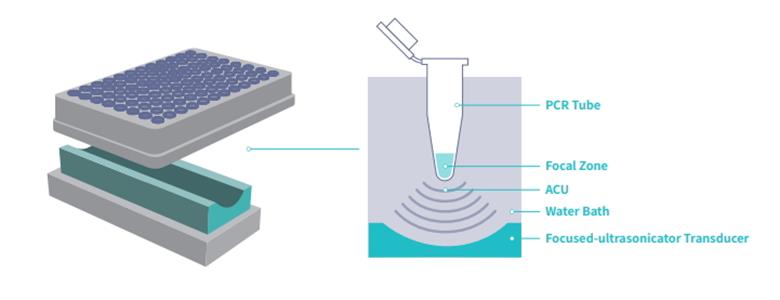
The LivoBot focused-ultrasonicator utilizes non-contact ACU™ (Adaptive Cylindrical Ultrasonic) focusing technology. This technology uses a custom-developed cylindrical ultrasonic transducer to geometrically focus high-frequency acoustic energy with a wavelength of approximately several millimeters onto the sample region, generating ... moreAdaptive Cylindrical Ultrasonic Technology https://www.livobottech.com/adaptive-cylindrical-ultrasonic-technology.html #next#generation#sequencing#technologies
The LivoBot focused-ultrasonicator utilizes non-contact ACU™ (Adaptive Cylindrical Ultrasonic) focusing technology. This technology uses a custom-developed cylindrical ultrasonic transducer to geometrically focus high-frequency acoustic energy with a wavelength of approximately several millimeters onto the sample region, generating high-intensity acoustic energy pulses. By adjusting parameters such as peak power, pulse duration, and duty cycle, the acoustic energy is controlled to induce cavitation effects within the sample container. The oscillation and collapse of these cavitation bubbles produce acoustic microstreaming, which generates powerful hydrodynamic shear stress in the sample, thereby achieving sample fragmentation.
Conventional ultrasound fragmentation devices often suffer from issues such as difficult energy control and excessive heating, which compromise sample processing quality. The ACU™ technology used in the EoSonics® FRAG series focused ultrasonicator overcomes these limitations by focusing acoustic energy, utilizing a low-temperature coupling fluid environment, and enabling precise positional control. With extremely low energy input, it achieves accurate sample shearing while avoiding over-processing and thermal damage. This provides an efficient, controllable, and stable environment for sample processing, effectively preserving the biological activity of samples.
Leveraging an advanced acoustic control algorithm, the system precisely regulates key parameters of the acoustic pulses including peak power, pulse duration, interval period, and duty cycle to modulate the output acoustic energy. This enables it to meet the precise energy and processing time requirements of different sample types and experimental applications, supporting a wide range of processing needs from gentle extraction to efficient fragmentation. During sample processing, the system continuously monitors acoustic parameters and automatically adjusts the acoustic output through a feedback mechanism, ensuring process stability and consistency. Even when sample properties or experimental conditions vary, it consistently delivers high-quality results.
Last posted by Henry Christ on July 15 2024 at 06:04 AM
In today's digital age, reliable USB charging cables are essential companions for our smartphones and devices. Whether you're looking for a durable USB-A, versatile USB-C, traditional...
6D Technologies, a leader in Telco Cloudification, has partnered with Amazon Web Services (AWS) to revolutionize telecom services. The collaboration integrates 6D Technologies' forward-looking so...
In 2024, the 3D printing industry stands at a transformative juncture, largely influenced by the ripple effects of COVID-19. Despite an initial dip in sales, the pandemic highlighted additive man...
Victoria's Secret & Co. (VS&Co) and Google Cloud have unveiled a strategic multi-year partnership ahead of NRF 2024, the retail industry's major event. This collaboration aims to leverage...
Black Sesame Technologies showcased groundbreaking innovations at CES 2024, unveiling the Huashan Series A1000, an automotive-grade autonomous driving chip. Recognized as China's first single-SoC...
Can you tell us about your background and journey that led you to establish cyberconIQ?
I am both an academic and a consultant/entrepreneur who has been studying technology trends, information p...