


Honeycomb Core Materials Market to Reach USD 11.07 Billion by 2034, Driven by Aerospace Innovation and Lightweight Material Demand
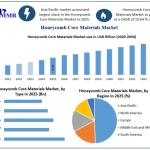
The Honeycomb Core Materials Market was valued at USD 4.45 billion in 2025 and is projected to reach nearly USD 11.07 billion by 2034, growing at a compound annual growth rate (CAGR) of 10.64% during the forecast period from 2026 to 2034. Increasing demand for lightweight structural materials, expanding aerospace manufacturing, and growing applications in automotive, marine, construction, and renewable energy industries are supporting market expansion.
Honeycomb Core Materials Market Estimation and Growth Drivers
The Honeycomb Core Materials Market is gaining momentum as manufacturers seek materials that combine low weight with high strength, stiffness, and energy absorption. Honeycomb structures feature a cellular design that provides excellent mechanical performance while reducing overall component weight. These characteristics make them suitable for aircraft panels, interior structures, spacecraft components, transportation equipment, and industrial applications.
The aerospace and defense industries are significant growth drivers because aircraft manufacturers continuously work to reduce structural weight, improve fuel efficiency, and increase payload capacity. Honeycomb core materials are widely used in sandwich panels for aircraft floors, cabin interiors, walls, doors, and other structural components. Growing commercial aircraft production, defense modernization programs, and increasing investments in advanced aerospace engineering are creating opportunities for material suppliers.
The automotive industry is another important contributor. Electric vehicle manufacturers are increasingly exploring lightweight materials to improve driving range and energy efficiency. Honeycomb structures can support lightweight body components, interior panels, battery enclosures, and energy-absorbing structures. In addition, the marine industry uses these materials in lightweight panels and interior structures, while construction applications include architectural panels, partitions, and specialized building components.
Technological advancements in aluminum, aramid paper, thermoplastic, and composite honeycomb structures are creating further opportunities. Manufacturers are focusing on improved bonding techniques, corrosion resistance, fire performance, and automated production processes. The increasing adoption of recyclable materials and advanced manufacturing methods is also encouraging product development across multiple industries.
Receive a Free Sample Copy Instantly : https://www.maximizemarketresearch.com/request-sample/448/
United States Market Trends and Investment Outlook
In 2025, the United States remained an important market for honeycomb core materials, supported by aerospace manufacturing, defense procurement, advanced composites development, and demand for lightweight transportation structures. Investments in commercial aircraft production, military aircraft modernization, space systems, and unmanned aerial vehicles are strengthening demand for engineered sandwich panels. The continued development of advanced air mobility and next-generation aircraft is also creating opportunities for high-performance core materials. At the same time, manufacturers are emphasizing production efficiency, material qualification, supply-chain resilience, and improved fire-resistant and sustainable material technologies. Federal aerospace and defense programs, alongside broader advanced-manufacturing initiatives, support the industrial ecosystem in which honeycomb materials are used. These trends position the United States as a strategic market for suppliers serving aircraft manufacturers, defense contractors, and composite component producers.
Honeycomb Core Materials Market Segmentation
The market is segmented according to material type, application, and end-use industry. Based on the market's segmentation framework, the leading segments are important indicators of demand across manufacturing applications. However, specific segment shares and the highest-share categories should be confirmed against the detailed segmentation data in the market report rather than assumed.
By material type, honeycomb cores can include aluminum, Nomex and other aramid-based materials, thermoplastics, and composite materials. Aluminum honeycomb is valued for its strength-to-weight ratio and structural performance, while aramid-based cores are used in aerospace applications requiring lightweight construction and particular fire-performance characteristics.
By application, honeycomb materials are used in sandwich panels, flooring, interior components, structural panels, and energy-absorbing systems. Aerospace and defense applications remain particularly important because of stringent requirements for weight reduction, durability, and structural efficiency. Automotive, marine, construction, and other industrial applications provide additional avenues for market development.
Competitive Analysis: Top Companies and Strategic Developments
Competition in the Honeycomb Core Materials Market centers on product performance, manufacturing capabilities, material innovation, aerospace certifications, and customer relationships. The following five companies are prominent industry participants; their individual global market shares are not publicly established in the available market information.
- Hexcel Corporation: Hexcel supplies advanced composite materials and aluminum honeycomb products for aerospace and industrial applications. Its HexWeb honeycomb portfolio supports lightweight structural designs. Continued development of specialized cores, improved manufacturing efficiency, and materials for demanding aerospace environments can strengthen its competitive position.
- Honicel: Honicel specializes in paper honeycomb structures used in packaging, furniture, doors, and construction. Its lightweight and resource-efficient products offer opportunities as manufacturers seek alternatives to heavier solid materials and conventional packaging solutions.
- Packaging Corporation of America (PCA): PCA participates in the paper-based packaging industry, where honeycomb-related products can serve protective packaging and industrial applications. Demand for recyclable packaging, material efficiency, and reduced transportation weight creates opportunities for innovation and market expansion.
- Argosy International: Argosy supplies aluminum and aramid-paper honeycomb cores for industrial and aerospace applications. Its product portfolio includes different aluminum grades and vented honeycomb structures. Continued product customization and reliable supply to composite manufacturers can support adoption in specialized engineering applications.
- Euro-Composites: Euro-Composites develops advanced composite materials and honeycomb core products for aerospace and industrial uses. Its focus on lightweight structures, specialized core configurations, and high-performance composite solutions supports applications requiring strength, precision, and dependable structural performance.
Across the competitive landscape, investment in automated production, advanced bonding, customized cell geometries, quality control, and thermoplastic materials can improve productivity and expand application possibilities. Company-specific investment announcements and policy changes should be distinguished from broader industry trends.
Regional Analysis: United States, United Kingdom, Germany, France, Japan, and China
United States: The country benefits from a substantial aerospace and defense manufacturing base, commercial aircraft programs, and space-sector investment. Federal defense procurement and aerospace research support demand for lightweight, high-performance structural materials. However, a precise US share of global honeycomb core materials revenue is not established here.
United Kingdom: Aerospace engineering, aircraft component manufacturing, and composite-material research support demand. Government-backed aerospace innovation and industrial decarbonization initiatives encourage manufacturers to improve efficiency and develop advanced lightweight structures.
Germany: Germany's automotive, industrial engineering, and aerospace sectors create opportunities for honeycomb cores. Automotive lightweighting, electric vehicle development, and European sustainability objectives support interest in efficient structural materials and recyclable composite solutions.
France: France benefits from its aerospace ecosystem, aircraft manufacturing activities, and composite engineering expertise. Aerospace research and industrial investment encourage the adoption of lightweight panels and advanced materials in aircraft and transportation applications.
Japan: Japan's automotive manufacturing, advanced materials expertise, and aerospace development activities support market opportunities. Lightweight vehicle design, manufacturing automation, and research into high-performance polymers and composites can expand applications.
China: China's aerospace manufacturing, transportation infrastructure, automotive production, and industrial development support honeycomb materials demand. Government initiatives focused on advanced manufacturing, electric mobility, and industrial modernization create opportunities for domestic producers. Asia-Pacific is identified as the leading regional market in the market overview, although comparable country-level market shares are not specified.
Key Players in the Honeycomb Core Materials Market
Major companies operating in the market include:
- Hexcel Corporation
- Honicel
- Packaging Corporation of America (PCA)
- Argosy International
- Euro-Composites
- Grigeo
- Dufaylite Developments
- Cartoflex
- Corinth Group
- Axxion Group
- Koninklijke Ten Cate B.V.
- Tubus Baer GmbH
- Universal Metaltek
- Lsquare Eco-Products
- Ti-Vu Plast
- Corex Honeycomb
- Suzhou Beecore Honeycomb Materials
- Rhinokore Composite Solutions
- Benecore
- Tricel Honeycomb Corporation
- Advanced Honeycomb Technologies (AHT)
- Thermhex Waben GmbH
- The Gill Corporation
- Samia Canada
- Honeycomb Cellpack
Why This Market Matters Now
The Honeycomb Core Materials Market matters because industries are under increasing pressure to reduce weight, improve energy efficiency, enhance structural performance, and minimize material consumption. Honeycomb structures address these priorities through their high strength-to-weight ratio and versatile design. Aircraft manufacturers can use them to reduce structural weight, automotive companies can explore them for lightweight components, and construction businesses can adopt them in efficient panel systems. Growing interest in recyclable materials, thermoplastic cores, and automated manufacturing further expands commercial opportunities. Despite challenges such as high material costs, bonding complexity, and performance limitations in certain environments, continued innovation and broader industrial adoption are expected to support market growth through 2034.
Explore More Related Reports
Global Low Profile Additives Market https://www.maximizemarketresearch.com/market-report/global-low-profile-additives-market/26874/
Hydrazine Hydrate Market https://www.maximizemarketresearch.com/market-report/hydrazine-hydrate-market/198713/
About Maximize Market Research
Maximize Market Research Pvt. Ltd. (MMR) is a global market research and consulting company that provides reliable, data-focused, and practical business insights. The firm serves a wide range of industries, including healthcare, pharmaceuticals, technology, automotive, electronics, chemicals, personal care, and consumer goods. Through market forecasts, competitive analysis, strategic consulting, and industry impact assessments, MMR helps organizations understand changing market conditions, identify growth opportunities, and make informed business decisions for long-term success.
Contact Us
Maximize Market Research Pvt. Ltd.
2nd Floor, Navale IT Park Phase 3
Pune Banglore Highway, Narhe
Pune, Maharashtra 411041, India
Phone: +91 9607365656
Email: [email protected]