
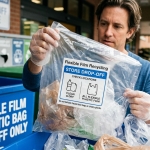

You flip over a bag of salad greens or a padded mailer and spot a small printed graphic near the seam. It looks like fine print, so most people skip it. That small graphic is often the clearest instruction you will get about flexible film recycling. It tells you which part of the package it covers, what it is made of, and where it should go when you are done with it. This guide explains how to read the How2Recycle label and how to act on it with confidence.
Why film packaging needs clear instructions
Flexible packaging comes in dozens of forms. Bread bags, case wrap around bottled water, air pillows, cereal liners, and zip-top bags all look similar at a glance. Some belong in a store drop-off bin. Others belong in the trash because they contain layers that recyclers cannot separate. Guessing wrong in either direction hurts flexible film recycling. Good film ends up in a landfill, or bad film contaminates a bale that a recycler then rejects. A standardized label removes the guesswork and gives shoppers one consistent place to look.
What the How2Recycle label is
The How2Recycle label is a third-party, standardized labeling system used on packaging sold in the United States and Canada. Packaging companies apply to use it, and the program evaluates each package against recycling access data and material compatibility before a label is approved. The result is a short, consistent set of symbols and words that shows up across many product categories. For flexible film recycling, it is one of the most direct tools a shopper has, because it addresses film specifically instead of plastic in general.
The label does not appear on every package. Using it is voluntary, so plenty of film that qualifies for flexible film recycling carries no label at all. When it is present, though, it reflects a review of that package rather than a broad claim about plastic.
The parts of a label
Each label breaks a package into its components and gives flexible film recycling instructions for every film piece. A complete label usually includes:
- A recyclability category, such as Store Drop-Off, Widely Recyclable, Check Locally, or Not Yet Recyclable
- The name of the component, such as bag, wrap, film, tray, or box
- The material, such as plastic or paper
- A preparation note, such as "Clean & Dry" or "Empty"
Reading all four parts together tells you exactly what to do with each piece. A box of crackers, for example, might list the paper box as widely recyclable and the inner film liner as Store Drop-Off. That level of detail is what makes the label so useful for flexible film recycling. You can separate the parts at home and send each one to the right place.
Store Drop-Off: the label that matters most for film
The Store Drop-Off category is the one to watch. It means the film component can go into a retail collection bin, usually found near a store entrance. Curbside recycling facilities cannot handle thin film, because it tangles in their sorting screens. Store drop-off programs exist to give flexible film recycling its own clean collection stream.
In flexible film recycling, a Store Drop-Off label typically appears on items made of polyethylene film, the stretchy plastic marked with resin codes #2 or #4. Common examples include:
- Bread bags and produce bags
- Case wrap from bottled water and paper towels
- Dry cleaning bags
- Shipping envelopes made only of plastic
- Air pillows from online orders, once deflated
Most Store Drop-Off labels come with a "Clean & Dry" note. Take that note seriously. Food residue, moisture, and paper receipts are the leading causes of contaminated film. One dirty bag will not ruin a bale, but many dirty bags will. Following the preparation note protects the value of the whole load and keeps flexible film recycling programs running.
Two other categories you will see on film
Two other categories often appear on flexible packaging, and each one changes your flexible film recycling decision.
Check Locally means access varies by community. Some areas run pilot programs that collect certain flexible items at the curb, at public drop-off sites, or through subscription services. Most communities do not. If you see this category on film, look up your local program before you place it in any bin. Assuming your curbside cart accepts film is one of the most common mistakes in flexible film recycling.
Not Yet Recyclable means no established recycling path exists for that component today. You will see this label on many multi-layer pouches, such as chip bags, coffee bags, and pet food bags. These packages bond plastic to foil or to other plastics, and recyclers cannot pull the layers apart. Put these items in the trash. Dropping them into a store bin feels helpful, but it lowers the quality of the film that flexible film recycling depends on.
What the preparation notes mean
The small instruction under each category matters to flexible film recycling as much as the category itself. "Clean & Dry" asks you to remove food and moisture. A quick wipe with a dry cloth is usually enough. "Empty" means the package should hold nothing when you recycle it, including crumbs or loose product. Some film labels also ask you to remove a paper label or a rigid component first.
These notes exist because recyclers wash and melt film as one material. Paper, food, and hard plastic pieces behave differently under heat and leave defects in recycled pellets. When you follow the notes, you hand the recycler material it can actually use. That one habit does more for flexible film recycling than almost anything else a household can do.
Packages with more than one part
Many packages combine materials, which makes flexible film recycling a little harder to sort out at home. A frozen meal can have a paper sleeve, a plastic tray, and a film lid. A box of tea can have a paper carton and individually wrapped film packets. The label lists each part separately for this reason.
Treat each line on the label as its own instruction. Recycle the parts that are accepted and throw away the parts that are not. Do not leave a film component attached to a paper box and hope the system sorts it out. Separating components at home is a small step that makes flexible film recycling and paper recycling work better at the same time.
What to do when there is no label
Since the label is voluntary, you will often find film with no instructions printed on it. You still have reliable ways to decide. Start with the resin code. Film marked #2 or #4 is usually accepted at store drop-off locations. Then try the stretch test. Pull the film gently with both hands. If it stretches like a sandwich bag, it is likely polyethylene and a good candidate for flexible film recycling. If it crinkles, tears cleanly, or feels stiff, it probably contains other materials and should go in the trash.
You can also check a flexible film recycling list of accepted items before you head out. A printed or online guide that shows real examples removes most of the doubt. If you are still unsure about an item, leave it out. A bin with less film in it is better than a bin full of contamination.
Common label mistakes to avoid
Even careful recyclers misread labels sometimes, and small errors add up across flexible film recycling programs. Watch for these:
- Treating the chasing arrows or a resin code alone as proof that an item is recyclable
- Placing Store Drop-Off film in a curbside cart
- Ignoring the "Clean & Dry" note on bags that held produce or bread
- Recycling a whole package when the label marks one part as Not Yet Recyclable
- Assuming that film without a label cannot be recycled
Each of these mistakes either sends good film to a landfill or pushes bad film into the stream. Avoiding them is an easy way to support flexible film recycling every week.
Why labels help the whole system
The benefit reaches far beyond one shopper sorting one bag. When millions of people follow the same instructions, store bins fill with cleaner film. Recyclers receive better bales, produce higher quality pellets, and pay more for the material. Manufacturers then have a steady supply to turn into composite lumber, construction materials, and new film. Clear labeling strengthens every link in flexible film recycling, from the store entrance to the factory floor.
Labels also push packaging design toward flexible film recycling. A company that wants a Store Drop-Off label has a reason to choose film that recyclers can process. Over time, that pressure moves more packaging into a recyclable format.
Put the label to work with Plastic Film Recycling
The How2Recycle label turns a confusing package into a short set of clear steps. Find the category, check the component and material, and follow the preparation note. When the label says Store Drop-Off, you still need a place to take your film. Plastic Film Recycling helps with that final step. Our map tool shows store drop-off locations near you, and our recycling guide lists the bags, wraps, and mailers that bins accept. Visit Plastic Film Recycling to find a location and make every label you read count toward flexible film recycling in your community.