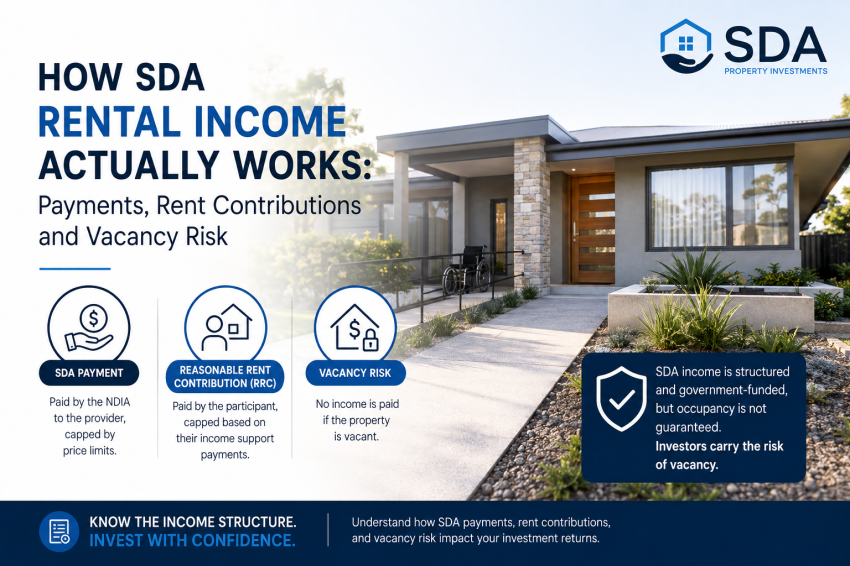
How SDA Rental Income Actually Works: Payments, Rent Contributions and Vacancy Risk
Most people researching SDA property investment focus on price limits and design categories, but far fewer understand exactly how the money flows once a participant moves in. If you're weighing up SDA properties for sale, knowing how income is structured and what happens when a home sits empty is just as important as knowing the build cost. This gap trips up a lot of new investors, so here's a clear, practical ... moreHow SDA Rental Income Actually Works: Payments, Rent Contributions and Vacancy Risk
Most people researching SDA property investment focus on price limits and design categories, but far fewer understand exactly how the money flows once a participant moves in. If you're weighing up SDA properties for sale, knowing how income is structured and what happens when a home sits empty is just as important as knowing the build cost. This gap trips up a lot of new investors, so here's a clear, practical breakdown.
Two Separate Income Streams, Not One Rent Cheque
Unlike a standard rental property, SDA housing income isn't a single payment from one tenant. It's made up of two distinct contributions:
1. The NDIA's SDA payment. This is paid directly to the registered SDA provider once a participant with SDA funding in their plan is living in the enrolled dwelling. The amount is capped by the price limits set out in the NDIS SDA Pricing Arrangements, which vary according to SDA design categories, building type, location and the number of residents.
2. The participant's Reasonable Rent Contribution (RRC). A SDA provider cannot charge a participant more than the maximum reasonable rent contribution published in the NDIS SDA Pricing Arrangements. In practice this contribution is typically calculated as a percentage of the participant's Disability Support Pension plus any Commonwealth Rent Assistance they receive, meaning it's capped regardless of which SDA housing category the person lives in.
NDIS
Both payments only start once the dwelling is enrolled and a participant is actually residing there which is where vacancy risk comes in.
Why Vacancy Is the Investor's Real Risk
You won't receive income from an SDA dwelling if an eligible participant isn't living in it, and the NDIA doesn't guarantee, back or assure investment returns for SDA investors carry the risk of vacancy themselves. This is an important distinction from the phrase "government-backed rental income," which is often used loosely in marketing. The SDA payment framework is government-funded and predictable once tenanted, but it is not a guaranteed income stream the property still needs to attract and retain a suitable resident.
NDIS
The NDIA doesn't place or match participants to a dwelling; where someone chooses to live is entirely their decision, including when a vacancy opens up after a resident leaves. That means an investor's outcome depends heavily on location, design quality and how well the provider manages tenant relationships not on any automatic allocation process.
NDIS
There is some cushioning built into the system. A short-term vacancy payment can apply in limited circumstances where a participant is temporarily absent (for example, a hospital stay), but this isn't a substitute for ongoing occupancy and shouldn't be relied on as core income.
What This Means for SDA Investors
Don't underwrite a purchase on price-limit figures alone. The maximum SDA price is a ceiling, not a promise — actual income depends on occupancy.
Ask about demand at the specific location, not just the state. Two properties in the same SDA design categories say, High Physical Support SDA versus Fully Accessible SDA can perform very differently depending on local need.
Understand who covers what. The RRC is capped and modest; it will never make up a large share of total income, but it confirms the participant is genuinely resident and enrolled.
Factor in provider performance. Since the RRC and SDA payment both flow through the SDA provider, a provider with a poor track record of tenant matching or property management directly affects how consistently you're paid.
Treat vacancy periods as a real cost, not a remote possibility, when modelling any projected return.
A Note on Design and Compliance
Income eligibility ties back to SDA compliance a dwelling only attracts SDA payments once it's built to the SDA Design Standard and formally enrolled with the NDIA. This is one more reason due diligence on certification documents matters as much as due diligence on the numbers; an uncertified or incorrectly categorised property simply won't generate the income the price guide suggests.
FAQs
Does the government guarantee my SDA rental income?
No. The NDIA and the Australian Government do not guarantee or assure investment returns for SDA, and investors carry vacancy risk. The payment framework is structured and funded through the NDIS, but occupancy is not automatic.
NDIS
How much does a participant actually pay towards rent?
Participant contributions are capped under the Maximum Reasonable Rent Contribution rules and are generally based on a portion of their pension plus any rent assistance, rather than the property's SDA category.
What happens financially if a dwelling is vacant?
Generally, no SDA payment or rent contribution is received while the dwelling is unoccupied by an eligible participant, aside from limited short-term vacancy provisions in specific circumstances.
Who is responsible for finding a tenant?
The SDA provider manages tenant sourcing and day-to-day operations. The NDIA is not involved in day-to-day management and doesn't place participants in dwellings.
NDIS
Does the SDA design category affect how much rent a participant pays?
Not directly. The participant's contribution is capped by their own income support payment, while the SDA payment component (paid to the provider) varies by design category and building type.
Where can I check current SDA price limits?
The current figures are published in the NDIS SDA Pricing Arrangements, updated annually by the NDIA.