

Outdoor lighting plays an important role in the daily operation of factories, warehouses, industrial parks and commercial premises. From internal roads and loading areas to parking spaces and security entrances, adequate illumination helps people and vehicles move around a site after sunset. For businesses managing large outdoor areas, solar street lighting is worth considering as an alternative to conventional grid-powered systems.
Industrial solar street lights use solar energy to power LED lighting after dark. They can be particularly useful in locations where extending electrical connections to every lighting point is difficult or where businesses want to reduce their dependence on grid electricity.
Why Industrial Sites Need Reliable Outdoor Lighting
Industrial facilities often operate beyond regular office hours. Employees may work night shifts, delivery vehicles may arrive late, and security teams may need to monitor entrances and boundary roads throughout the night.
Poorly planned lighting can leave dark patches around vehicle routes, warehouse entrances and open storage areas. A suitable lighting arrangement helps improve visibility and supports the movement of people and vehicles.
Factories, logistics centres, commercial campuses and industrial estates have different requirements. Therefore, businesses should assess the size of the area, road layout, operating schedule and required brightness before selecting outdoor lighting equipment.
How Solar Street Lights Work
A typical solar street lighting system combines a solar panel, LED luminaire, rechargeable battery and charge controller. The solar panel collects sunlight during the day, and the energy is stored in the battery for use after sunset.
Depending on the system, components may include LiFePO4 batteries and MPPT charge controllers. LiFePO4 batteries provide energy storage, while MPPT controllers help optimise the collection of available solar power.
The performance of a solar street light depends on the complete system, not just the wattage printed on the product. Solar panel capacity, battery backup, daily operating hours, weather conditions and installation location all affect its suitability.
Applications Across Industrial and Commercial Areas
Factory roads: Internal roads connect production buildings, storage facilities and dispatch areas. Solar street lighting can be considered for these routes after assessing road width, traffic movement and required illumination.
Warehouses and logistics centres: Outdoor loading areas, vehicle parking spaces and access roads may benefit from appropriately planned solar lighting. The lighting system should match the site's operating hours and visibility requirements.
Industrial parks: Large industrial developments often contain multiple roads, pathways and shared access points. Solar-powered lighting can be an option for selected areas, particularly where grid connections are inconvenient.
Commercial complexes: Shopping complexes, office campuses and business premises may use outdoor lighting around entrances, parking areas and internal roads.
Remote access roads: Locations with limited electrical infrastructure can be evaluated for off-grid solar lighting. The system must be sized to provide the required illumination under local weather conditions.
What to Consider Before Buying Industrial Solar Street Lights
Selecting the right equipment requires more than comparing prices. Businesses should consider several factors before making a decision.
Lighting requirements: Identify the areas that need illumination and determine the appropriate brightness and light distribution. Wider roads and larger spaces may require a different arrangement from entrances or pathways.
Solar panel performance: The panel should generate enough energy for the intended operating schedule. Shading, seasonal sunlight and local weather conditions should be considered during planning.
Battery capacity: Battery capacity affects how much energy is available after sunset. Buyers should check the expected operating duration and backup performance during periods of limited sunlight.
Weather resistance: Outdoor lighting equipment in India may face dust, rain, heat and humidity. Check the product's stated protection rating and suitability for the installation environment.
Maintenance: Solar panels require periodic cleaning, while batteries and electrical components should be inspected according to the manufacturer's instructions. Understanding maintenance requirements helps businesses plan for long-term ownership.
Total cost: Consider equipment, installation, mounting structures, maintenance and future battery replacement. A system should be evaluated according to its overall suitability rather than its initial price alone.
Exploring Industrial Solar Lighting from Zitroen
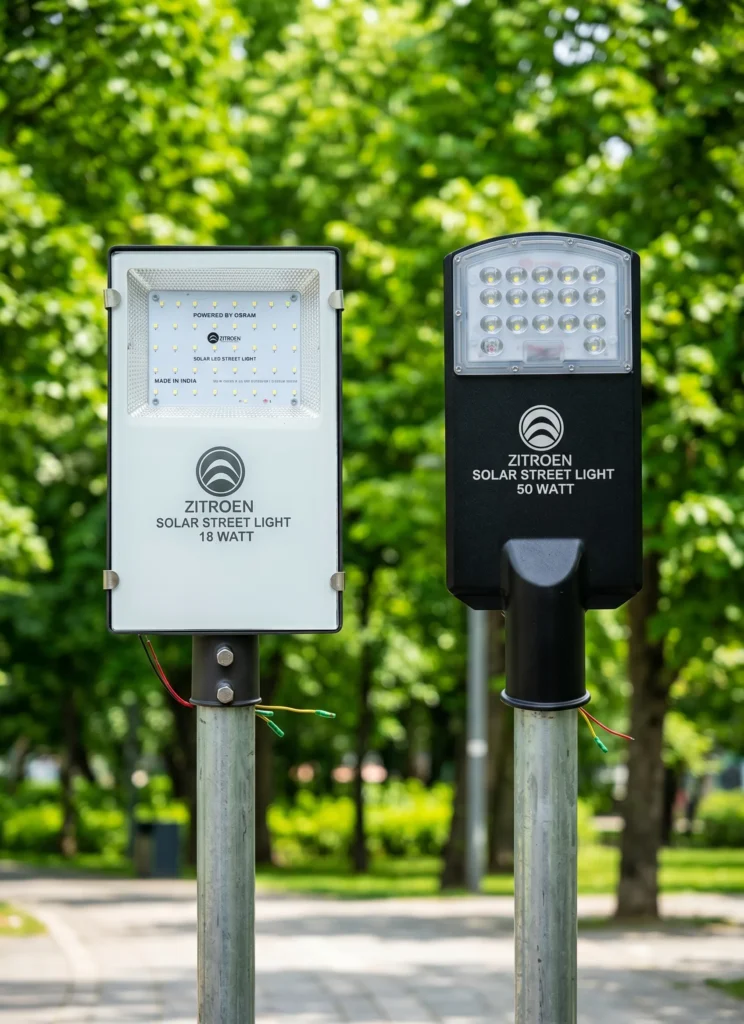
Zitroen IoT Private Limited, based in Pune, Maharashtra, offers industrial solar street lights in a range of approximately 60W to 600W. Its lighting portfolio also includes solar street lights, LED lighting, flood lights, highbay lights and other lighting solutions.
Businesses planning outdoor lighting for factories, warehouses, industrial parks and commercial premises can explore Zitroen's industrial solar street lights to review the available range.
Before selecting a model, buyers should confirm the specific product's specifications, battery backup, operating duration, warranty and installation requirements. This helps ensure that the selected system matches the actual demands of the site.
When evaluating a Solar street light manufacturer in India, businesses should look for product information that supports a clear comparison of lighting requirements, system components and maintenance needs. A suitable supplier should help buyers identify the right configuration for their intended application.
Conclusion
Industrial solar street lighting can be a practical option for factories, warehouses, industrial parks and large commercial outdoor spaces. By using solar energy, these systems can reduce dependence on grid electricity at suitable lighting points.
The best results begin with careful planning. Assessing illumination needs, solar panel capacity, battery performance, weather resistance and maintenance requirements helps businesses make informed decisions. With the right configuration, solar-powered outdoor lighting can support industrial infrastructure while contributing to more energy-conscious operations.